








The Fiorenzato Allground Sense Plus is the updated version of a grinder we now know inside out. We tested the original non-scale version (without "Sense" in its name), the model sold as the Sense until June 2025, and now the Plus version—the latest iteration of this grinder.
The Allground Sense Plus is a hopper-fed grinder featuring integrated scales for Grind by Weight and 64 mm flat burrs. Retailing at around €850 at Stoll Espresso (or roughly CHF 900 in Switzerland), it targets upper-tier home baristas. As always, we bought the grinder ourselves—or rather multiple times over the years! The updates over its predecessor: a new, cleaner, oval-shaped display and minor software refinements. Mechanically—burr set, chamber, declumper flapper—the Plus model is identical to the previous version. That means its strengths remain intact, and so do its weaknesses. The changes are subtle enough that some retailers don't even advertise it explicitly as a "Plus" version. However, the Plus model introduced in June 2025 has completely replaced its predecessor. If you own the pre-June 2025 version, don't worry: in our view, there are no differences in grind or in-cup quality.
Design & Build Quality
Weighing 9 kg and standing 44 cm tall, the Allground Sense Plus has a solid, heavy-duty presence on the counter. Full metal housing, high-grade build quality, no wobbles, and tight seams throughout. The portafilter fork holds firmly: lock in, grind, release. The new display is a noticeable visual upgrade. Matching the oval curve of the housing, the IPS screen is easy to read from wider side angles and offers better color contrast.
One notable software update: dose programming now goes up to 50 g—on the older model, single doses were capped at 12 g. It's not a game-changer, but it gives you extra head-room if you experiment with larger portafilter baskets or filter coffee brewing.
The printed grind indicator scale is noticeably coarser than the actual internal adjustment steps. This remains a genuine flaw that's hard to understand: why hasn't Fiorenzato refined this simple indicator mark since launching the original Allground? The red vertical line indicator is wider than 1.5 dots on the dial, and the dots themselves are quite wide. They align with the stepped click mechanism. Since numerical markings are missing, adjusting grind size requires counting dots manually whenever you want to return to a previous setting.

The community has devised workaround solutions—custom stickers, 3D-printed pointers, or aftermarket scales. Having users resort to 3D-printing platforms to fix a design detail that the manufacturer hasn't addressed in five years doesn't speak well of their responsiveness to user feedback.
Cleaning access remains exceptional. You can access the grinding chamber in seconds without tools—just twist, unlatch, brush, and reassemble. It's a benchmark for the industry. We give cleaning accessibility a "lime green" rating only because changing burr position requires recalibrating your grind setting. Otherwise, getting into the heart of the grinder is effortlessly fast.

Germany: Stoll Espresso, Bohnendealer, Lücke Technik
Switzerland: Adrianos
Austria: Bohnendealer
We recommend specialty retail partners known for reliable service and support. Purchasing through these affiliate links incurs no extra cost to you, while yielding a small commission that directly supports our testing lab.
Burr Set & Mechanics
The core engine of the Allground Sense Plus: 64 mm flat steel burrs running at a fixed 1,600 RPM (no variable RPM control). It is designed specifically for hopper use with integrated scales; while single dosing is technically possible, it isn't its primary use case.
Grind size adjustment is stepped. A detent pin drops into notches along the ring, locking the setting with an audible click. Without that pin, the collar would turn steplessly. You can position the collar between clicks on top of the notch ridge, though doing so requires a delicate touch.
If you stick strictly to the notches, shot times jump by 3 to 4 seconds per click. That means finding your exact target extraction time relying purely on the default steps is almost impossible. Resting the collar between clicks bypasses this limitation, allowing you to dial in far more accurately.
Our critique stands: if you stick to one roast and lock in your setting, it works smoothly. But if you frequently swap coffees or adjust recipes, the click step size will be frustrating unless you use the between-click trick.

Grinding Speed & Noise Level
Grinding 18 g in 8 seconds is quick and plenty fast for home use. Running continuously for 10 seconds dispenses 23.8 g. That speed handles back-to-back shots easily when entertaining guests, making it a great option for light commercial or pop-up catering setups.
Noise level measures 84.1 dB(A) at 20 cm distance. That lands at the upper end of what we consider "moderate": noticeable, but not harsh. The sound profile is deep and smooth without high-pitched whines or motor strain. It's a loud sound, but of a refined, pleasant frequency—and at just 8 seconds per dose, it's over quickly.
Grind Temperature & Consistency
Ground coffee starts at 29.6 °C and rises modestly to 32.0 °C after five consecutive doses. Thermal buildup is minimal and won't affect taste in daily use.
As for dosing consistency: standard deviation across 10 doses measured an extraordinary 0.067 g. Sequential output weights ran like this: 17.9 – 18.0 – 17.9 – 18.0 – 18.0 – 18.0 – 17.9 grams. The Grind-by-Weight system delivers on its promise: dose after dose, even when switching coffees without recalibration. A 0.1 g variance is within the margin of error of most scales. No misreads, no portafilter detection issues, no wild outliers.
A crucial quality benchmark for GbW grinders is counter vibration tolerance. Early scale-integrated grinders used to stop grinding if someone walked heavily past the counter.
The Fiorenzato Allground Sense handles counter vibrations well across both versions. The Plus model stops grinding if it detects sudden heavy vibration and resumes once movement settles. The earlier version kept grinding while showing fluctuating values, recovering accuracy once movement stopped. Provided counter movement isn't severe, both models hit target weight accurately.
Retention
Total retention measures 7.1 g—comprising 6.6 g temporary retention and 0.5 g permanent retention. This hasn't changed on the Plus version, as the chamber and declumper design remain identical. A temporary retention of 6.6 g is significant.
Here is why retention matters, and who it affects most:
In practice: purge grounds whenever you change grind size. We program Button 1 to a 6 g purge dose for this purpose.
If you pull several espressos consecutively, retention is less noticeable since coffee doesn't sit in the chute for long.
Dial-in Repeatability
In our repeatability test—Espresso (T4) → Ristretto (T5) → Lungo (T6) → return to Espresso (T7)—the Allground Sense Plus demonstrated a clear strength: the x50 particle size shifted by only ~11 µm between baseline (262.3 µm) and return (273.2 µm). For a stepped dial, that is impressive repeatability. The detent clicks firmly into place.
The paradox remains: repeatability is great, but finding the exact sweet spot between two clicks remains tricky unless you balance the collar between notches.

Particle Size Distribution
We analyze particle distribution in partnership with the ZHAW Coffee Excellence Center using a Retsch Camsizer X2.
Espresso setting (T4):
x50: 262.3 µm – Fines (<100 µm): 31.8% – 60% Peak Width: 177.7 µm
A fine fraction of 31.8% is high: delivering rich body, mouthfeel, and extraction resistance in the puck. High fines can indicate poor burrs or, as is the case here, very uniform burrs with a narrow primary peak. At 177.7 µm, the main peak is remarkably narrow. This produces a clean, structured extraction despite the high fines percentage.
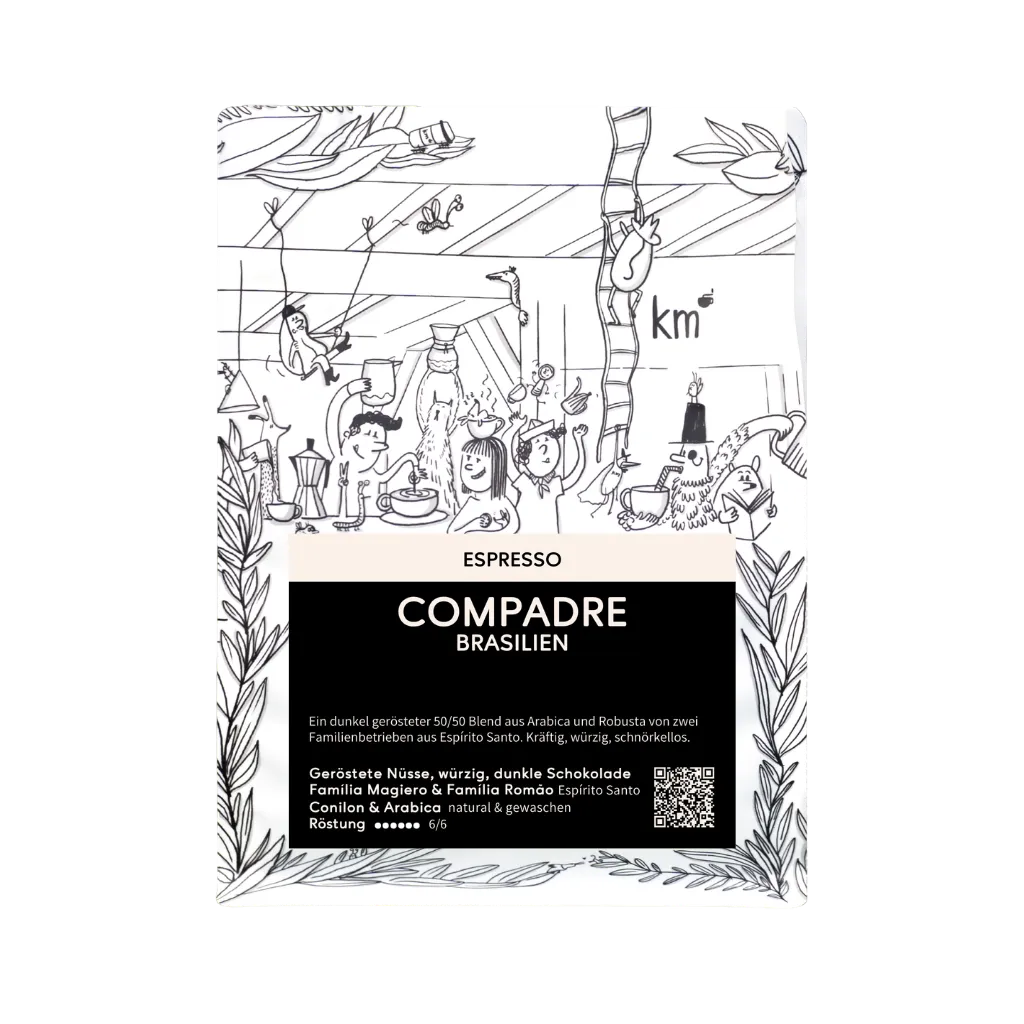
The burrs grind with high uniformity—and you taste that clarity in the cup. What this means in practice: the Allground Sense Plus isn't limited to one roast style. It handles everything from light specialty roasts (like our Lila line) to dark, traditional Italian espresso profiles like Compadre.
Tasting Notes
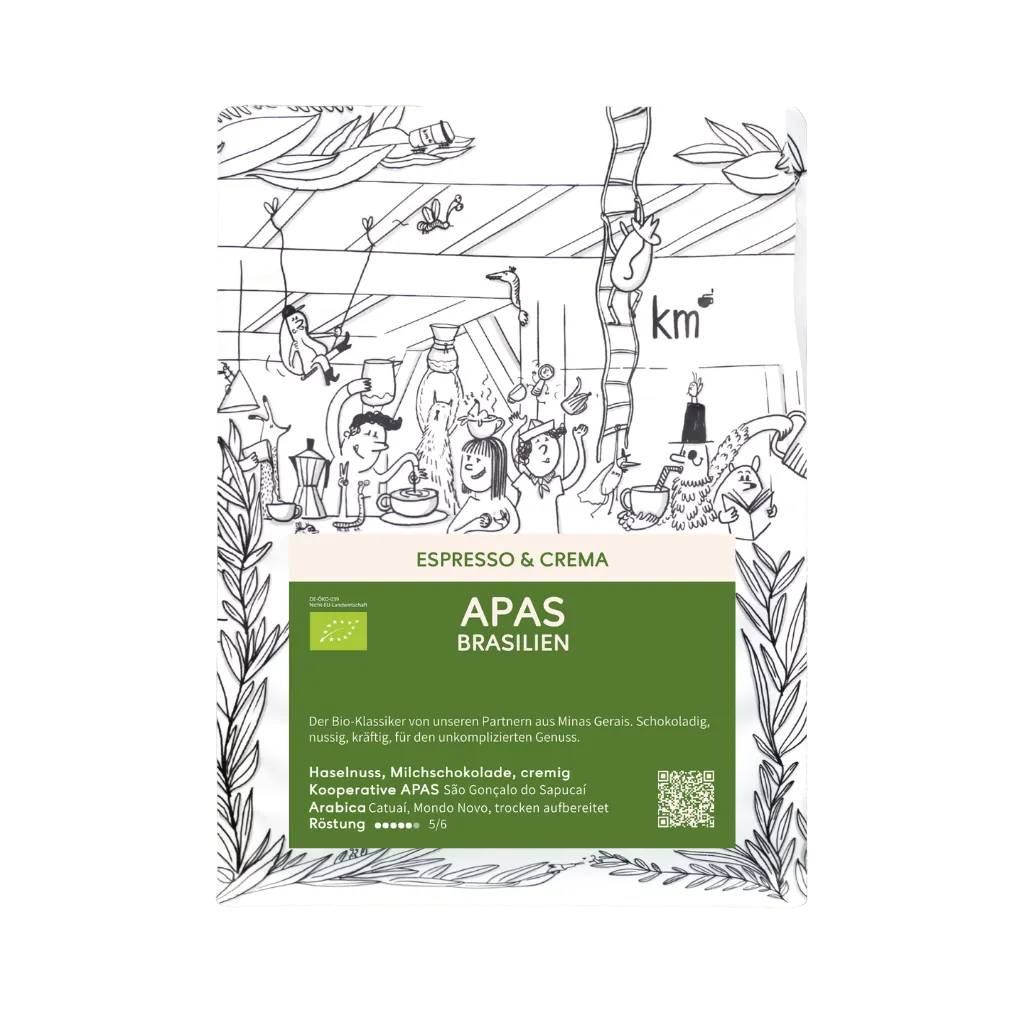
In blind tasting using our Apas Espresso (18 g in, 42 g out in 25 seconds), the Allground Sense Plus showed a clear signature: high sweetness, silky texture, and heavy body. The finish is long with lingering cocoa notes. It also revealed a crisp stone fruit note that rarely comes through so clearly on this coffee.
This matches our lab particle analysis: high fines, narrow peak, body-forward cup with structured clarity. A great pairing for both specialty beans and traditional dark roasts.
A workflow tip: you don't need a WDT tool with this grinder. Grounds exit the chute fluffy and centered into the portafilter.
Verdict
The Fiorenzato Allground Sense Plus is a very good grinder. That is the bottom line.
It has two persistent flaws that the manufacturer hasn't resolved in years. One can be worked around via community mods or careful positioning between clicks. The other (retention) is manageable if you grind frequently throughout the day—though purging is necessary when switching beans.
The stepped dial remains our primary frustration, and we hope Fiorenzato delivers a true stepless update in future iterations.
Pros
Cons
Who is it for?
Baristas who pull multiple espressos daily, stick to one house coffee bean, and want a set-and-forget Grind-by-Weight workflow. Anyone who prioritizes easy cleaning, heavy-duty build quality, and outstanding in-cup taste at a fair price point.
Light Commercial Use? It is remarkably fast and quiet, making it a strong contender for pop-up bars or small office environments where coffee turns over quickly and retention becomes irrelevant.
Who is it NOT for?
Home baristas who switch coffee beans constantly or demand micro-stepless control over extraction times. Anyone who pulls only 1–2 espressos per day with long gaps between shots will find the 6.6 g temporary retention frustrating without purging.
Value for Money:
At around €850 for an accurate GbW system, great particle distribution, tool-free maintenance, and robust build quality, the value is fair. If Fiorenzato addresses the stepped dial and retention in future updates, this grinder will have few equals in its class.
To see how the Allground Sense Plus compares against competing scale-integrated grinders, check out our Grind-by-Weight Comparison Guide.

Technical Specifications
| Specification | Value |
|---|---|
| Price | ~€850 / CHF 900 retail |
| Burr Diameter | 64 mm |
| Burr Type | Flat steel burrs |
| Operating Mode | Hopper (GbW) |
| Grinding Speed | 23.8 g / 10 sec; 8.0 sec for 18 g dose |
| Noise Level | 84.1 dB(A) |
| Grind Temperature | 29.6–32.0 °C (1st to 5th dose) |
| Absolute Retention | 7.1 g (6.6 g temporary, 0.5 g permanent) |
| Consistency (Std Dev) | 0.067 g |
| x50 (Espresso Setting) | 262.3 µm |
| Fines (<100 µm) | 31.8 % |
| 60% Peak Width | 177.7 µm |
| RPM Adjustment | No (Fixed 1,600 RPM) |
| Weight | 9.0 kg |
| Bean Hopper Capacity | 500 g |
| Grind Adjustment | Stepped (Notched ring, unnumbered) |
| Key Features | Integrated GbW scale, tool-free chamber access |


